reabc/Understanding Case Law and Legal Writing - Frederick Ray/Understanding Case Law and Legal Writing - Frederick Ray.pdf
Web PDF • Imposed PDF• Raw TXT (OCR)
![counsel’s actions are unreasonable. Counsel couldn’t possibly say it was a strategic choice 10 violate the standards of his profession. To satisfy the prejudice prong of an ineflectiveness claim, you must demonstrate that counsel’s act or omission had an effect on the outcome of the procecdings. Com. v Marshall 663 4.2d 1100, 1103 (Pa 1993). You must plead (write it) and demonstrate (show how) that there’s a reasonable probability that, but for the act or omission challenged, there’s a likelihood you ‘would’ve been found not guilty of the specific charge or charges. Com, v Jones 683 A.2d 1181, 1188 (Pa 1996). This doesn’t mean you have to prove you would have been “absolutely” found not guilty, only that there’s a “reasonable likelihood” there would’ve been a difference outcome. ‘When you understand the legal principles governing ineffective assistance of counsel claims, you will be able to demonstrate in your pleadings how your issues will be proved by developing your argument through the circumstances of your case. The discussion of the circumstances include not only the totality of the evidence that was introduced at trial but also facts concerning the prosecution of the case and how counsel’s acts and omissions affected the process of ascertaining the truth and as a result the verdict is unreliable. Com. v Rivers 786 4.2 923, 927.930 (Pa 2001). Boilerplate pleadings such as “counsel did not have a reasonable basis for his act or omission” or “the outcome could’ve been different,” without more, s insufficient. You ‘must develop an argument in support of those: conclusions. Rivers at 931. In conclusion, Couns effective and you hay proving otherwise. 7] do it for you. You mus court how you’re right That rightness is not n ‘perception of whats 1 law. What’s wrong in ‘wrong according to la proves you right.Its a and if you don’t know a victim of the game r There’s o much more copying language fron it 1o the court. You m: doctrine and principle language. ‘There are no instant. ‘wands in this game o power and your proteg ‘When you know truth don’t. The truth is in what’s said. You must 10 read. You can’t get circumstances and be ‘accomplishing your go ‘movie- don’t walk out because you’re at the There 10 elevator to the stairs. Defeat come solutions that don’t something different different. | FIGHT THE POWE} **FOR EDUCATIONAL ’RESEARCH THE LAW. ACCURACY OF. "ANALYSIS EXPRESSED AND NOT THE HUMA | 6l |](Understanding Case Law and Legal Writing - Frederick Ray 4.png)
l is “presumed” to be
e the brden of
e court is not going to
¢ show and prove the
and why you're right.
casured by your
ght; it’s measured by
<ality might not bo
v. You use law that
game governed by rules
those rules you become
ther than a player in it
this game than
case and presenting
st understand the legal
that created that
nswers or magic
law. Knowledge is
ou can identify who
ose books, not in
ead, read, and continue
here any other way.
tic despite the
rindful that
s is like watching a
o the movie just
art you don’t like.
cosss, you must take
from clinging to
i until you do
1 won't get anything
..AND WIN 1t
URPOSES ONLY, ALWAYS
URSELF TO VERIFY THE
S LEGAL ANALYSIS. THE
THAT OF THE AUTHOR
RIGHTS COALITION**
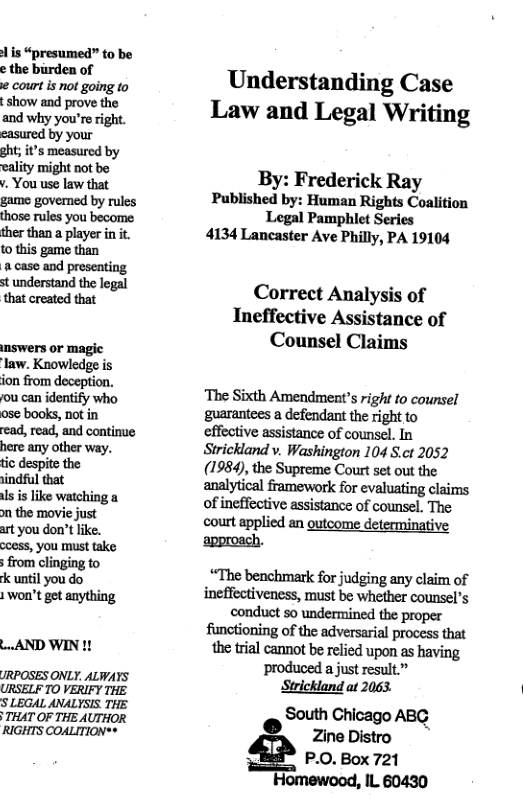
Understanding Case
Law and Legal Writing
By: Frederick Ray
Published by: Human Rights Coalition
Legal Pamphlet Series
4134 Lancaster Ave Philly, PA 19104
Correct Analysis of
Ineffective Assistance of
Counsel Claims
The Sixth Amendment’s right fo counsel
‘guarantees a defendant the right to
effective assistance of counsel. In
StricKland v. Washington 104 S.ct 2052
(1984), the Supreme Court set out the
analytical framework for evaluating claims
of ineffective assistance of counsel. The
court applied an outcome determinative
approach.
“The benchmark for judging any claim of
ineffectiveness, must be whether counsel’s
conduct so undermined the proper
functioning of the adversarial process that
the trial cannot be relied upon as having
‘produced a just result.”
Strickland at 2063.
South hicago ABG
. Zine Distro
P.O. Box 721
Homewood, IL 60430
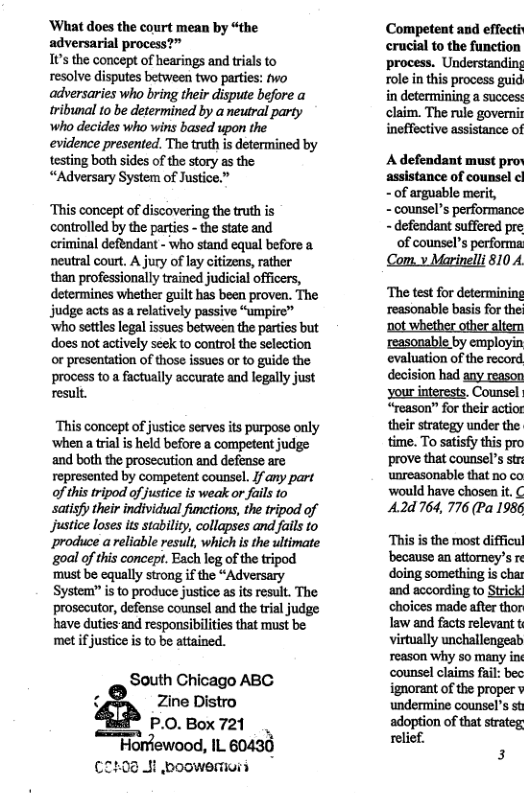
‘What does the court mean by “the
adversarial process?”
16s the concept of hearings and trials to
resolve disputes between two partis: two
adversaries who bring their dispute before a
tribunal 10 be determined by a neutral party
'who decides who wins based upon the
evidence presented. The truth is determined by
testing both sides of the story as the
“Adversary System of Justice.”
‘This concept of discovering the truth is
controlled by the parties - the state and
criminal deftndant - who stand equal before
neutral court. A jury of Iay citizens, rather
than professionally trained judicial officers,
determines whether guilt has been proven. The
judge acts as a relatively passive “umpire™
‘Who settles legal issues between the parties but
does not actively seek to control the selection
or presentation of those issues or to guide the
process to a factually accurate and legally just
result
‘This concept of justice serves its purpose only
‘whena trial is held before a competent judge
and both the prosecution and defense are:
represented by competent counsel. Jf any part
of this tripod of justice is weak or fails 1o
satisfy their indvidual fumctions, the tripod of
Justice loses it stability, collapses and fails to
‘produce a reliable result, which s the wltimate
goal of this concept. Each leg of the tripod
‘must be equally strong if the “Adversary
System” is to produce justice as its result. The
prosccutor, defense counsel and the trial judge
have duties and responsibilities that must be
metif justice s to be attained.
‘South Chicago ABC
u’é Zine Distro
P.O. Box 721
Flomewood, IL 60430
C2H02 Ji poowermiuin
Competent and effecti
crucial to the function
process. Understanding
role in this process guid
in determining a success
claim. The rule governi
ineffective assistance of
A defendant must pro
assistance of counsel c
- of arguable merit,
- counsel’s performance
- defendant suffered pre
of counsel’s performa
Com. v Marinelli 810 A
‘The test for determining
reasonable basis for thei
‘not whether other altern
‘reasonable by employin
evaluation of the record.
decision had any reason
‘your interests. Counsel
“reason” for their actior
their strategy under the
time. To satisfy this pro
prove that counsel’s sr
unreasonable that no co
would have chosen it.
A4.2d 764,776 (Pa 1986
“This is the most dificu
‘because an attorney’s re
and according to Strick
choices made after thor
law and facts relevant t
virtually unchallengeab
reason why so many in
counsel claims fal: bec
ignorant of the proper v
undermine counsel’s st
adoption of that strateg
relief.
3
e defense counsel is
of the adversarial
defense counsel’s
s the proper analysis
ful ineffective counsel
g the analysis of an
claim is well settled .
e that his ineffective
aim is:
was unreasonable
udice as a result
ce.
2d 1257 (Pa 2002),
whether counsel has a
¢ act or omission, is
tives were more
a hindsight analysis
but whether counsel’s
able basis to advance
reed only state a
and categorize it as
ircumstances at the
ng of test, you must
tegic decision was so
npetent attomey
om. v. Albrech 511
)
prong to prove
ason for doing or not
scterized as “strategy”
ugh investigation of
) plausible options are:
e...” This is the
flective assistance of
ause defendants are
ay to challenge and
ategy and the court’s
to justify denying
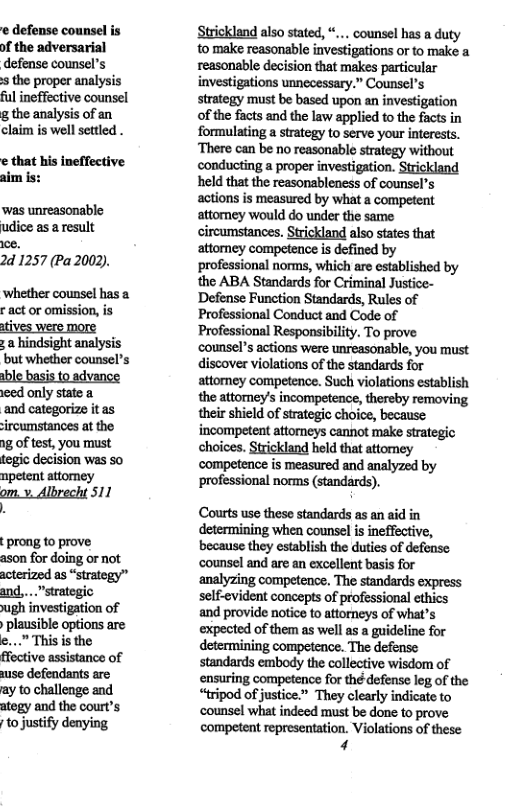
Strickland also stated, ... counsel has a duty
to make reasonable investigations or to make a
reasonable decision that makes particular
investigations unnecessary.” Counsel's
strategy must be based upon an investigation
of the facts and the law applied to the facts in
formulating a strategy to serve your interests.
There can be no reasonable strategy without
conducting a proper investigation. Strickland
held that the reasonableness of counsel’s
actions is measured by what a competent
attomey would do under the same
circumstances. Strickland also states that
attomey competence is defined by
professional norms, which are established by
the ABA Standards for Criminal Justice-
Defense Function Standards, Rules of
Professional Conduct and Code of
Professional Responsibility. To prove
‘counsel’s actions were unreasonable, you must
discover violations of the standards for
attomey competence. Such violations establish
the attomey's incompetence, thereby removing
their shield of strategic choice, because
incompetent attomeys cannot make strategic
choices. Strickland held that attomey
competence is measured and analyzed by
professional norms (standards).
Courts use these standards as an aid in
determining when counsel is ineffective,
because they establish the duties of defense
counsel and are an excellent basis for
‘analyzing competence. The standards express
self-evident concepts of professional ethics
and provide notice to attorneys of what's
expected of them as well as a guideline for
determining competence. The defense
standards embody the collective wisdom of
ensuring competence for thé defense leg of the
“tripod of justice.” They clearly indicate to
counsel what indeed must be done to prove
competent representation. Violations of these
4
counsel’s actions are unreasonable. Counsel
couldn’t possibly say it was a strategic choice
10 violate the standards of his profession.
To satisfy the prejudice prong of an
ineflectiveness claim, you must demonstrate
that counsel’s act or omission had an
effect on the outcome of the procecdings.
Com. v Marshall 663 4.2d 1100, 1103 (Pa
1993). You must plead (write it) and
demonstrate (show how) that there’s a
reasonable probability that, but for the act or
omission challenged, there’s a likelihood you
‘would’ve been found not guilty of the specific
charge or charges. Com, v Jones 683 A.2d
1181, 1188 (Pa 1996). This doesn’t mean you
have to prove you would have been
“absolutely” found not guilty, only that there’s
a “reasonable likelihood” there would've been
a difference outcome.
‘When you understand the legal principles
governing ineffective assistance of counsel
claims, you will be able to demonstrate in
your pleadings how your issues will be proved
by developing your argument through the
circumstances of your case. The discussion of
the circumstances include not only the totality
of the evidence that was introduced at trial but
also facts concerning the prosecution of the
case and how counsel’s acts and omissions
affected the process of ascertaining the truth
and as a result the verdict is unreliable. Com. v
Rivers 786 4.2 923, 927.930 (Pa 2001).
Boilerplate pleadings such as “counsel did not
have a reasonable basis for his act or
omission” or “the outcome could’ve been
different,” without more, s insufficient. You
‘must develop an argument in support of those:
conclusions. Rivers at 931.
In conclusion, Couns
effective and you hay
proving otherwise. 7]
do it for you. You mus
court how you're right
That rightness is not n
‘perception of whats 1
law. What's wrong in
‘wrong according to la
proves you right.Its a
and if you don’t know
a victim of the game r
There's o much more
copying language fron
it 1o the court. You m:
doctrine and principle
language.
‘There are no instant.
‘wands in this game o
power and your proteg
‘When you know truth
don’t. The truth is in
what's said. You must
10 read. You can’t get
circumstances and be
‘accomplishing your go
‘movie- don’t walk out
because you're at the
There 10 elevator to
the stairs. Defeat come
solutions that don’t
something different
different.
|
FIGHT THE POWE}
**FOR EDUCATIONAL
'RESEARCH THE LAW.
ACCURACY OF.
"ANALYSIS EXPRESSED
AND NOT THE HUMA
|
6l
|